
Insights
Loan Against Large Extent of Land in India: Eligibility, LTV, Documents & Funding Options
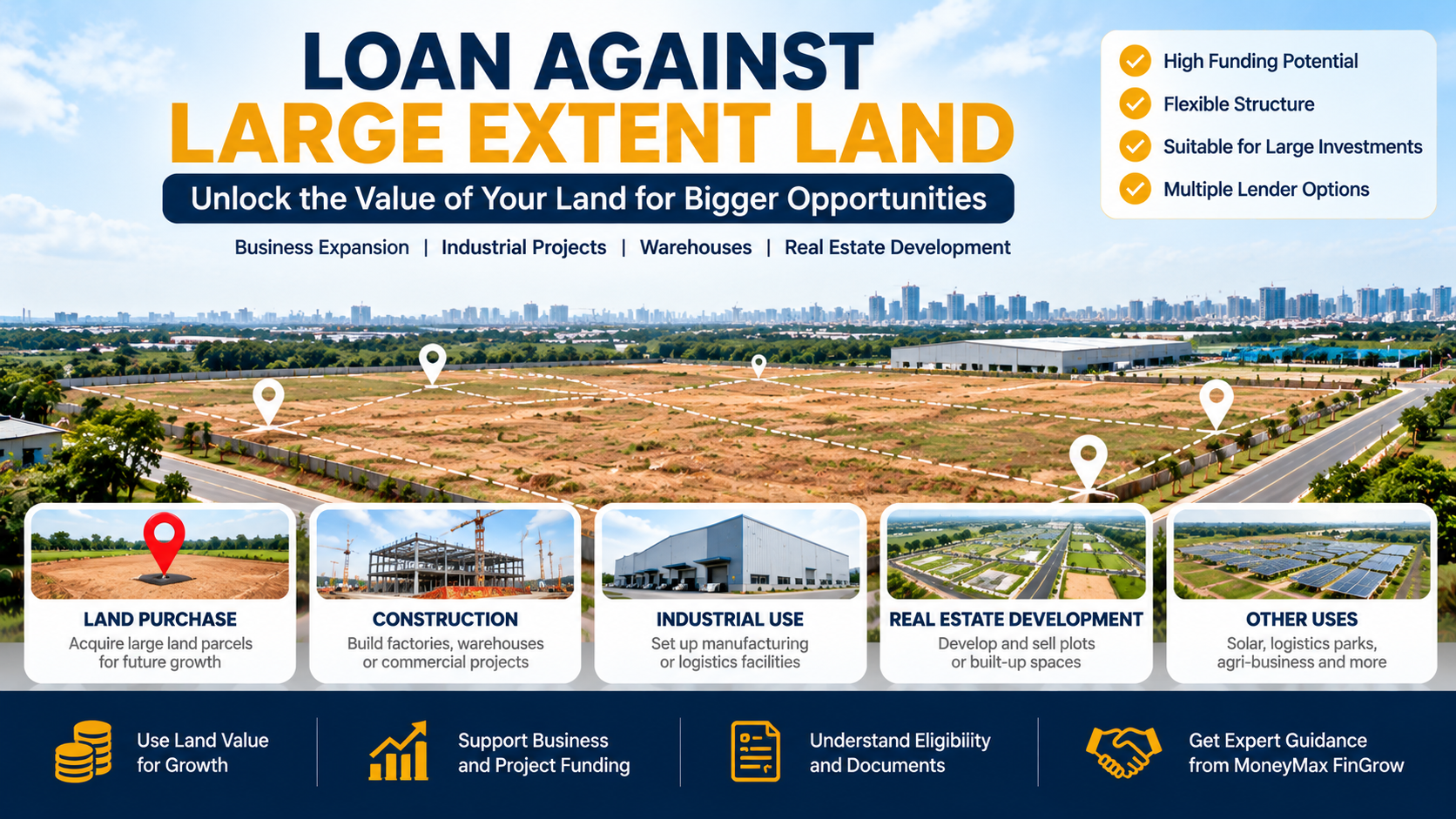
Own 5, 10 or 100 acres of land? Learn about loans against large land parcels in India, including eligibility, LTV, approvals, documents and funding options.
Loan Against Large Extent of Land in India: Eligibility, LTV, Documents & Funding Options
You Own 10 Acres of Land. Can You Get a Bank Loan Against It?
Imagine this.
You own 10 acres of land.
The property is located near a developing industrial corridor.
Its estimated market value is ₹20 crore.
You are planning to expand your business and need ₹8 crore.
You approach a bank and say:
"I own land worth ₹20 crore. Can I get ₹8 crore against it?"
The banker asks you three questions.
"Is the land agricultural or non-agricultural?"
"Is it approved for the proposed use?"
"What is the purpose of the loan?"
And suddenly, you realise something important.
**Owning a large extent of land does not automatically make you eligible for a large loan.**
In fact, financing against a large vacant land parcel can sometimes be more complicated than financing against a completed residential or commercial building.
Let us understand why.
1. What Is a Loan Against Large Extent of Land?
A loan against land is a secured funding facility in which an eligible parcel of land is offered as collateral.
The borrower may be an individual, business owner, company, or another legally eligible entity.
Depending on the land category and loan purpose, the facility may be structured as a mortgage-backed term loan, project loan, or another permitted secured lending product.
However, not every bank accepts vacant land under its standard Loan Against Property (LAP) scheme.
Some lenders prefer completed residential or commercial properties.
Others may consider eligible non-agricultural land or industrial plots under specific products.
**The first step is to identify the correct loan product, not merely the bank offering the lowest interest rate.**
2. Can You Get a Loan Against 5 Acres, 10 Acres, or 100 Acres?
Potentially, yes.
But there is no universal rule that says a bank will accept land simply because it measures 5, 10, or 100 acres.
The lender will evaluate:
- Land classification.
- Ownership and legal title.
- Approved land use.
- Location and road access.
- Property valuation.
- Marketability.
- Restrictions on mortgage or transfer.
- Proposed loan purpose.
- Borrower's repayment capacity.
A 2-acre approved commercial plot in a strong location may be easier for a particular lender to evaluate than a 50-acre parcel with unclear land classification and access.
**The size of the land is not the only factor. Its legal and commercial usability matters.**
3. Types of Large Land Parcels That May Be Considered
A. Industrial Land
Industrial land may be used for factories, manufacturing facilities, logistics parks, or other permitted industrial activities.
Some lenders consider eligible industrial land as collateral under specialised business finance products.
The lender may check whether the property is freehold or leasehold, whether industrial use is permitted, and whether approvals or authority permissions are required.
Industrial plots allotted by development authorities may have specific mortgage and transfer conditions.
B. Commercial Land
Commercial land may be intended for offices, showrooms, hotels, commercial complexes, or other permitted commercial developments.
Some lenders may evaluate eligible commercial land for secured funding.
The property's approved use, location, title, development potential, and marketability are important.
C. Residentially Approved Land
A large parcel approved for residential use may be considered by certain lenders.
However, acceptance depends on whether the lender finances vacant land and whether the property meets its policy.
A loan to purchase an approved residential plot is different from raising funds by mortgaging land you already own.
D. Agricultural Land
This requires special attention.
Agricultural land is generally excluded from many standard LAP products.
Eligible agricultural borrowers may have access to separate agriculture-related credit facilities, subject to applicable rules.
State laws may also impose restrictions on ownership, mortgage, transfer, or enforcement.
Do not assume agricultural land can be mortgaged for an unrelated commercial purpose.
E. Land Held for Future Development
Some landowners hold large parcels for future warehouses, factories, residential projects, or commercial developments.
Lenders may assess such properties under specialised project finance or secured lending structures.
The proposed project, land-use permissions, borrower contribution, and repayment plan may become more important than the land value alone.
4. Why Banks Are Careful About Large Vacant Land
Let me explain this with a simple example.
A completed commercial building may generate rental income.
A factory may support an operating business.
But vacant land may not generate any regular cash flow.
If the borrower cannot repay, the lender must consider how easily the property can be sold.
Large land parcels may have fewer potential buyers than smaller plots.
They may also require significant legal and technical verification.
Banks may be concerned about:
- Limited immediate income from the land.
- Difficulty finding buyers for a large parcel.
- Land-use restrictions.
- Unclear boundaries.
- Encroachments.
- Disputed ownership.
- Environmental or development restrictions.
- Lack of legal access.
- Restrictions on subdivision or transfer.
This is why two properties with the same estimated market value may receive very different lending decisions.
5. How Much Loan Can You Get Against Large Land?
This is the question most landowners ask.
Suppose your land is worth ₹20 crore.
Can you obtain ₹10 crore?
It depends.
First, the lender must accept the land category.
Second, the lender must determine an acceptable valuation.
Third, it must assess your financial eligibility and loan purpose.
For illustration:
| Hypothetical accepted land value | Illustrative LTV | Indicative loan | |---|---:|---:| | ₹5 crore | 40% | ₹2 crore | | ₹10 crore | 50% | ₹5 crore | | ₹20 crore | 40% | ₹8 crore | | ₹50 crore | 30% | ₹15 crore |
These are mathematical examples only. They are not published lending norms, guaranteed funding percentages, or promises that these land categories will be accepted.
Some lenders may not offer a standard LAP against vacant land at all.
**The loan amount depends on both collateral eligibility and repayment capacity.**
6. Does Land Location Affect Loan Eligibility?
Absolutely.
Consider two properties.
Property A is 10 acres of approved industrial land with clear road access and nearby industrial development.
Property B is 10 acres in a remote location with unclear access and uncertain permitted use.
Even if the owners believe both properties have similar market values, a lender may evaluate them differently.
Location influences marketability, demand, accessibility, development potential, and valuation.
However, a good location cannot compensate for defective legal title or prohibited mortgage arrangements.
7. Freehold Land vs Leasehold Land
Before applying, understand your ownership rights.
Freehold Land
Freehold ownership generally gives the owner broader rights over the property, subject to applicable laws and restrictions.
Lenders still verify title, encumbrances, land use, and mortgage eligibility.
Leasehold Land
Industrial or commercial land may be allotted on a long-term lease.
The lease may require approval from the development authority before a mortgage can be created.
The lender may also assess remaining lease tenure and restrictions on transfer.
**A leasehold plot is not automatically ineligible, but its financing conditions may be more complicated.**
8. Can You Get a Loan Against Land for Business Expansion?
Some lenders may consider eligible land as collateral for permitted business financing.
For example, a manufacturing company may require funds for machinery or capacity expansion.
The lender will assess the company's financial statements, existing commitments, business viability, and proposed use of funds.
The land may support the security requirement, but the business must still demonstrate repayment capacity.
**A valuable asset is not a substitute for a healthy cash flow.**
9. Loan Against Land for Warehouse Development
Suppose you own 8 acres of eligible industrial or commercial land.
You want to develop a warehouse.
Your funding requirement may involve construction, infrastructure, equipment, and working capital.
Instead of assuming that a standard LAP is the right option, evaluate a suitable warehouse construction or project finance facility.
The lender may require:
- Clear land title.
- Permitted land use.
- Required development approvals.
- Construction estimates.
- Project viability.
- Promoter contribution.
- Repayment projections.
- Suitable collateral and guarantees.
Where project finance is sanctioned, disbursement may be linked to milestones and compliance with loan conditions.
10. Loan Against Land for Industrial Development
Manufacturers may own large industrial plots and want to construct new factories.
The lender may evaluate a project finance or industrial term loan rather than a conventional LAP.
The project may require detailed cost estimates, statutory permissions, and evidence of promoter contribution.
The proposed business expansion must be financially viable.
11. Can You Mortgage Only Part of a Large Land Parcel?
This is an important question.
Suppose you own 20 acres but need funding against only 5 acres.
Can you mortgage a portion?
Possibly, if the parcel can be legally identified, subdivided or otherwise separately mortgaged in a manner acceptable to the lender.
The lender may require approved subdivision, separate survey records, clear access, and legally enforceable boundaries.
If the land cannot be separated legally, the lender may require security over a larger extent or reject the proposed arrangement.
Do not assume that any portion of a large property can be mortgaged independently.
12. Documents Required for Loan Against Large Extent of Land
Documentation is especially important for large parcels.
Depending on the state and property category, lenders may require:
Land Documents
- Registered sale deeds and title chain.
- Encumbrance certificate or equivalent records.
- Patta, mutation, or revenue records where applicable.
- Survey and subdivision records.
- Field measurement sketch or survey map where applicable.
- Land-use classification documents.
- Conversion or development permissions where applicable.
- Approved layout or planning permissions where applicable.
- Property tax or land revenue receipts.
- Lease or allotment documents where applicable.
- Mortgage permissions or NOCs where required.
Borrower Documents
- KYC documents.
- Income tax returns.
- Financial statements.
- Bank statements.
- Existing loan details.
- Business registration documents.
- Project report, where applicable.
- Details of the proposed loan utilisation.
The lender may request additional legal, technical, environmental, or regulatory documentation.
13. Common Reasons Banks Reject Land-Backed Loan Applications
Here are some reasons a lender may decline the proposal.
**1. Agricultural classification:** The property does not meet the selected product's collateral requirements.
**2. Unclear ownership:** The title chain is incomplete or disputed.
**3. Missing approvals:** The land cannot legally be used for the proposed purpose.
**4. No legal road access:** The property lacks acceptable access rights.
**5. Existing encumbrances:** The property is already charged or subject to restrictions.
**6. Weak repayment capacity:** The borrower cannot demonstrate sufficient income or business cash flow.
**7. Limited marketability:** The lender is uncomfortable with the property's saleability.
**8. Wrong loan product:** The applicant approached a lender that does not accept the land category.
A rejection should be understood before submitting the same application elsewhere.
14. Five Financial Questions to Ask Before Mortgaging Large Land
Before offering your land as collateral, ask yourself:
**Question 1:** Why do I need the loan?
**Question 2:** How much money do I genuinely need?
**Question 3:** What income or cash flow will repay the loan?
**Question 4:** What happens if the project takes longer than expected?
**Question 5:** Am I comfortable putting this property at risk if repayment fails?
These questions matter because secured borrowing carries consequences.
A lender may have enforcement rights over mortgaged property if the borrower defaults, subject to applicable law and loan terms.
15. Why Choosing the Right Lender Matters
Imagine an entrepreneur who owns 15 acres of industrial land.
The property is legally clear and located near an industrial hub.
The entrepreneur approaches a bank for a conventional LAP.
The bank declines because its LAP policy does not accept vacant industrial land.
Does that mean funding is impossible?
Not necessarily.
The borrower may need to evaluate a specialised industrial, project, or other secured lending product.
But if the land has a legal restriction or the borrower lacks repayment capacity, changing lenders may not solve the problem.
**The objective is to match the property, funding purpose, and financial eligibility with a suitable lender and product.**
Frequently Asked Questions
Can I get a loan against 10 acres of land?
Potentially, depending on land classification, ownership, mortgage permissions, lender policy, valuation, and repayment capacity.
Can I get a loan against 100 acres of land?
Large land parcels may be evaluated under specialised secured lending or project finance structures. Acreage alone does not determine eligibility.
Can I get a loan against vacant land?
Some lenders accept eligible vacant plots, while many standard LAP schemes restrict or exclude them.
Can I get a loan against agricultural land?
Standard LAP products often exclude agricultural land. Separate agriculture-related credit facilities may be available to eligible borrowers.
Can I mortgage industrial land for business expansion?
Some lenders consider eligible industrial land under secured business or project finance products, subject to their policies.
How much loan can I get against land worth ₹10 crore?
There is no universal percentage. The lender must first accept the property and then assess valuation, repayment capacity, and the applicable lending margin.
Can I mortgage part of my land?
Possibly, subject to legal subdivision or other acceptable identification of the mortgaged portion, clear access, and lender approval.
Can I get a loan against land without income proof?
Lenders generally require a verifiable source of repayment. Owning land alone does not guarantee loan approval.
Is a loan against land available in Chennai or Tamil Nadu?
Some lenders may consider eligible land in Chennai and Tamil Nadu, subject to property category, applicable state laws, location, approvals, and lender policy.
Final Thoughts
You may own 5 acres.
You may own 10 acres.
Or you may own 100 acres.
Your land may be worth several crores.
But remember:
**The value of your land does not automatically determine how much a bank will lend.**
What matters is the combination of legal eligibility, permitted land use, marketability, funding purpose, and repayment capacity.
Before approaching a lender, understand your land and your financial requirements.
Because the right funding decision begins with clarity.
Looking for Funding Against Large Land Parcels?
If you own industrial, commercial, or other potentially eligible land and want to explore suitable secured financing options, MoneyMax FinGrow Private Limited can help you evaluate your requirements.
Visit: https://moneymaxfingrow.com
**MoneyMax FinGrow Private Limited**
**Bank on Us, Not on the Bank.**
*Disclaimer: This article is educational. Not all land categories are accepted as collateral. Funding depends on lender policy, legal eligibility, property valuation, approved loan purpose, and repayment capacity. No loan approval or loan-to-value percentage is guaranteed.*
Comments
Be the first to comment on this article.