
Insights
Loan Against Property for Hospitals in India: Funding for Hospital Expansion, Equipment & Working Capital
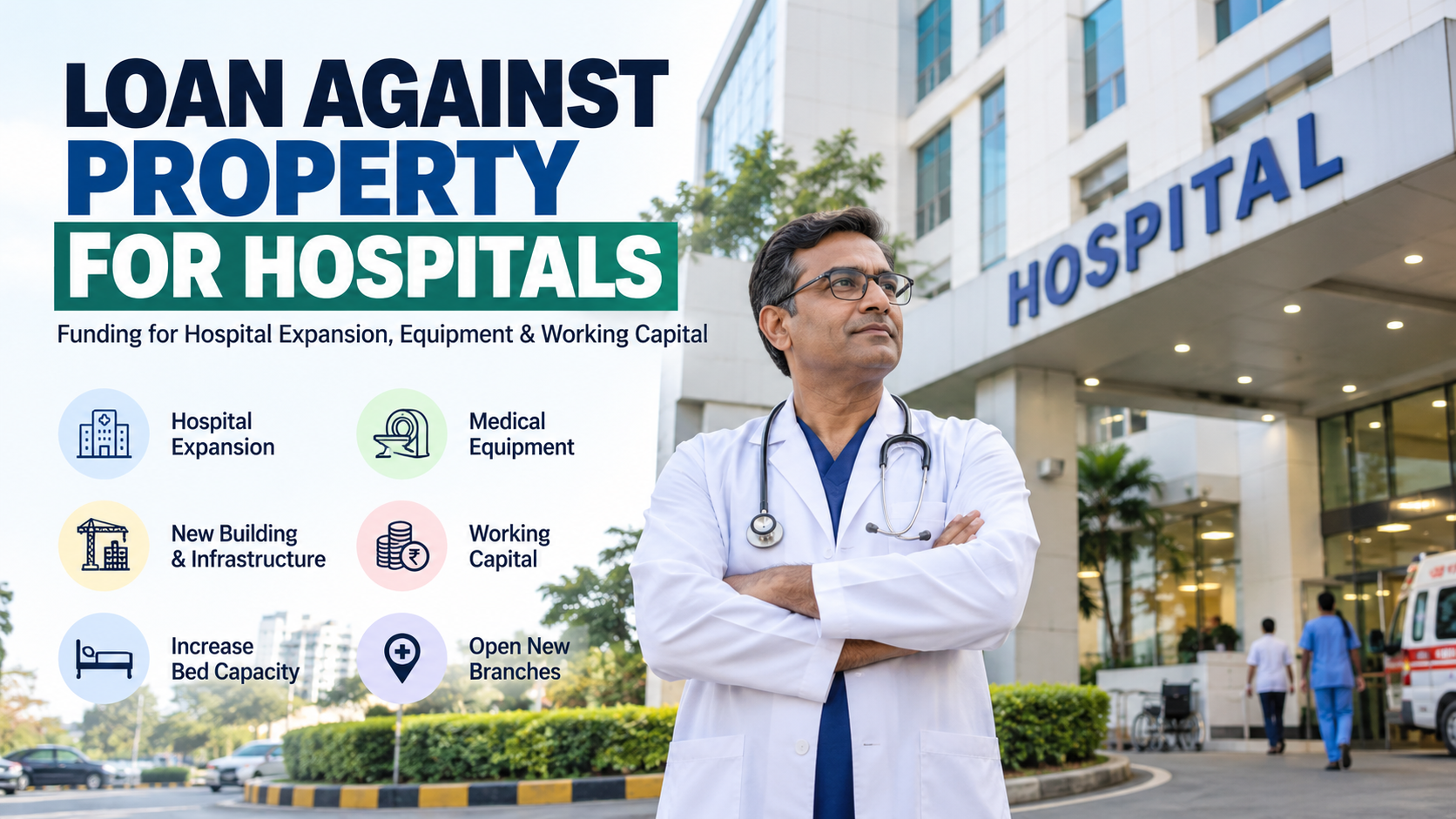
Explore Loan Against Property for hospitals in India. Learn eligibility, interest rates, documents and funding options for hospital expansion and equipment.
Loan Against Property for Hospitals in India: Your Hospital Is Growing. But Is Your Funding Keeping Up?
You started your hospital with a purpose.
To treat patients.
To save lives.
To provide better healthcare.
Maybe you started with a small clinic.
Then you added a few beds.
Then an operation theatre.
Then an ICU.
Today, you have a hospital with doctors, nurses, technicians, administrative staff, and hundreds of patients depending on your services.
Your hospital has grown.
But now you have another challenge.
**Your hospital needs more funds to grow further.**
You want to add more beds.
You want to purchase a CT scan or MRI machine.
You want to build another floor.
You want to upgrade your operation theatre.
You want to open another branch.
But where will the money come from?
This is where a **Loan Against Property (LAP) for hospitals** may help.
Let us understand how hospital owners and doctors can use eligible property to raise funds for healthcare business expansion.
1. What Is a Loan Against Property for Hospitals?
A Loan Against Property is a secured loan offered by banks and NBFCs against eligible property.
For example, suppose you own a hospital building worth ₹10 crore.
You need ₹4 crore to expand your hospital.
Instead of selling the property, you may be able to mortgage it to a bank or NBFC and raise funds, subject to eligibility and the lender's permitted end use.
The lender evaluates your property, hospital income, financial statements, existing liabilities, and repayment capacity.
The approved funds may then be used for permitted hospital business requirements.
But remember, the property is security for the loan. If the loan is not repaid, the lender may take enforcement action against the mortgaged property.
**Your hospital building is an asset. The question is whether borrowing against it will create sufficient additional value.**
2. Why Do Hospitals Need Funding?
Running a hospital is very different from running many other businesses.
You cannot simply stop operations when your cash flow is under pressure.
Patients need treatment.
Doctors and nurses need salaries.
Medical equipment needs maintenance.
Medicines and consumables must be available.
Electricity, oxygen, housekeeping, laboratory services, and emergency facilities must function.
At the same time, hospitals need to invest continuously in infrastructure and technology.
Let us look at some common funding requirements.
Expanding Hospital Bed Capacity
Imagine you are running a 30-bed hospital.
Your occupancy is improving, and you are regularly receiving enquiries for additional admissions.
You want to expand to 60 beds.
But expansion requires investment in civil work, patient rooms, medical equipment, furniture, electrical systems, and staffing.
A properly structured hospital expansion loan may help finance eligible costs.
Purchasing Medical Equipment
You want to introduce advanced diagnostic services.
You may need an MRI machine, CT scanner, ultrasound system, digital X-ray equipment, or other medical technology.
Instead of using all your existing working capital, you could evaluate equipment finance or an eligible secured loan.
Building Additional Hospital Infrastructure
Your hospital needs another floor, additional operating theatres, an ICU, or a diagnostic block.
This may require substantial capital.
Depending on the lender's policy and project structure, property-backed funding or a dedicated construction facility may be considered.
Opening Another Hospital Branch
Your existing hospital is performing well.
You identify an opportunity to open another branch in a nearby city.
Before investing, you must evaluate the new location, patient demand, expected occupancy, staffing, operating expenses, and projected cash flow.
Funding should support a viable expansion plan.
Managing Working Capital
Hospitals sometimes face delays in receiving payments from insurance companies, TPAs, and corporate clients.
But salaries, suppliers, and operating expenses cannot always wait.
A working capital facility may help bridge eligible short-term cash flow gaps.
However, a cash credit or overdraft facility may be more suitable than a long-term LAP for recurring working capital needs.
3. How Much Loan Can a Hospital Owner Get Against Property?
Let me explain with a simple example.
Suppose a hospital owner has an eligible property with an accepted lender valuation of ₹10 crore.
The possible loan amount will depend on the lender's Loan-to-Value policy and the hospital's repayment eligibility.
| Illustrative LTV | Loan amount | |---|---:| | 50% | ₹5 crore | | 60% | ₹6 crore | | 65% | ₹6.5 crore | | 70% | ₹7 crore |
These are only mathematical illustrations, not assured funding percentages for hospital properties.
Hospitals are specialised properties. Some lenders may apply stricter valuation, property acceptance, or LTV policies.
And here is something important.
**Just because your property is worth ₹10 crore does not mean you can automatically borrow ₹6 crore.**
The lender must also be satisfied that your hospital can repay the loan.
4. Can Doctors Get a Loan Against Property?
Yes. Eligible doctors, clinic owners, diagnostic centre owners, and hospital promoters may apply for LAP.
But there is a difference between a doctor's personal income and the income generated by a hospital business.
For example, a doctor may earn professional consultation income while also owning a hospital through a company or partnership.
The lender will examine the borrower structure, property ownership, financial records, and source of repayment.
Depending on the requirement, doctors may also compare professional loans, medical equipment loans, business loans, and other specialised healthcare funding products.
The right product depends on the purpose.
5. What Types of Hospital Properties Can Be Mortgaged?
Depending on the bank or NBFC policy, eligible collateral may include:
- Hospital buildings.
- Commercial properties owned by the promoter.
- Eligible residential properties.
- Diagnostic centre premises.
- Certain clinic buildings.
- Other acceptable commercial or industrial properties.
However, hospitals are specialised-use properties.
The lender may review land use, building approvals, ownership, occupancy, legal compliance, and the property's marketability.
A hospital building is not automatically acceptable collateral merely because it has a high market value.
6. Loan Against Property Interest Rates for Hospitals
Hospital owners frequently ask:
"What is the interest rate for a hospital loan?"
There is no single interest rate for all hospital borrowers.
The rate depends on the lender, borrower profile, property, credit history, business profitability, loan amount, and repayment risk.
Before selecting a lender, compare:
- Interest rate and whether it is fixed or floating.
- Loan tenure.
- Processing fees.
- Legal and valuation charges.
- Mortgage-related expenses.
- Prepayment conditions.
- Total interest payable.
**The lowest interest rate is not always the best funding solution.**
A loan with the wrong repayment structure can create unnecessary pressure on your hospital's cash flow.
7. Hospital Loan EMI: A Practical Example
Suppose your hospital needs ₹3 crore.
Assume the lender offers an illustrative annual interest rate of 10% with a tenure of 15 years.
Your approximate EMI would be ₹3.22 lakh per month.
Now ask yourself a few questions.
What is the hospital's current monthly cash surplus?
How much are you already paying towards existing loans?
What additional monthly cash flow will the expansion generate?
What happens if patient occupancy falls temporarily?
What happens if insurance reimbursements are delayed?
These questions matter more than simply knowing whether the bank will approve the loan.
**The right loan amount is the amount your hospital can repay comfortably, even during a difficult month.**
8. Documents Required for Hospital Loan Against Property
Hospitals may be operated as proprietorships, partnerships, LLPs, private limited companies, trusts, or other eligible entities.
The document requirements vary accordingly.
Financial Documents
Banks may request income tax returns, audited financial statements, bank statements, GST records where applicable, existing loan statements, and other income documents.
Hospital Business Documents
Depending on the facility and lender, documents may include hospital registration, clinical establishment approvals, applicable licences, and details of the operating entity.
Property Documents
These may include title deeds, parent documents, encumbrance records, building approvals, tax receipts, and other legal or technical documents.
Additional Business Information
For larger funding requirements, lenders may ask for a hospital expansion plan, equipment quotations, project cost estimates, projected financial statements, and details of the proposed source of repayment.
My suggestion is simple.
**Don't wait until you urgently need funds to prepare your documents.**
If you are planning hospital expansion in the next six months, start preparing now.
9. Seven Numbers Every Hospital Owner Should Know Before Borrowing
Before you approach a bank for hospital funding, understand these seven numbers.
**1. Monthly revenue:** How much income is your hospital generating?
**2. Variable expenses:** How much do medicines, consumables, diagnostics, and other activity-linked costs consume?
**3. Gross profit:** What remains after the relevant direct and variable costs?
**4. Fixed expenses:** How much do salaries, rent, administration, and other recurring commitments cost?
**5. Promoter salary:** Are you accounting for the owner's remuneration properly?
**6. Net profit:** What is the actual profit after relevant expenses?
**7. Available cash flow:** How much cash remains after collections, payments, taxes, working capital needs, and existing debt commitments?
The seventh number is especially important for repayment planning.
A hospital may report accounting profit while experiencing a cash shortage because insurance claims and receivables have not yet been collected.
**Profit is important. But your EMI is paid from cash flow.**
10. A Hospital Expansion Example
Let us take an imaginary example.
A hospital has 40 beds.
The promoter wants to expand to 80 beds.
The total project requirement is estimated at ₹5 crore.
The promoter plans to contribute ₹2 crore and raise ₹3 crore through suitable funding.
Before applying, the hospital owner should calculate:
- Construction and infrastructure cost.
- Equipment cost.
- Additional staffing expenses.
- Expected occupancy.
- Revenue per occupied bed.
- Expected collection period.
- Operating expenses.
- Monthly EMI and repayment capacity.
Suppose the expansion takes 12 months to complete.
The hospital may have to service interest before the additional capacity starts generating meaningful revenue.
This must be included in the funding plan.
A dedicated project or construction facility with an appropriate disbursement and repayment structure may be more suitable than a standard LAP.
**A hospital expansion plan should begin with financial clarity, not with a loan application.**
11. When Should Hospital Owners Avoid Taking LAP?
This is something I want every hospital owner to understand.
Do not rush into a property-backed loan if your hospital is consistently losing money without a realistic recovery plan.
Do not borrow simply because your property has appreciated.
Do not use long-term borrowed money to repeatedly cover avoidable operating losses.
Do not assume that additional beds will automatically create additional profit.
And never ignore the consequences of mortgaging a property that is essential for your hospital's operations.
Sometimes the first step should be improving occupancy, collections, cost control, operational efficiency, or profitability.
**Getting more funding is not always the solution. Sometimes managing existing money better is the solution.**
12. LAP vs Medical Equipment Loan vs Hospital Project Loan
| Funding option | Common purpose | |---|---| | Loan Against Property | Eligible business requirements backed by property | | Medical Equipment Loan | Purchase of eligible medical equipment | | Hospital Project Loan | Hospital construction or major expansion | | Working Capital Loan | Recurring operational funding needs | | Cash Credit / Overdraft | Eligible short-term cash flow requirements |
Each facility has different eligibility, security, tenure, disbursement, and repayment conditions.
A professional assessment helps identify the most suitable structure.
13. Why Should Hospital Owners Work With a Professional Loan Consultant?
Doctors are trained to diagnose and treat patients.
Hospital administrators focus on managing operations.
But arranging the right funding requires understanding bank policies, property valuation, financial analysis, cash flow, loan structuring, and documentation.
Different lenders may evaluate the same hospital differently.
At **MoneyMax FinGrow Private Limited**, we help business owners evaluate their funding requirements and suitable lending options.
Whether you are planning a hospital expansion, diagnostic centre, medical equipment investment, or another eligible healthcare business requirement, the starting point is financial clarity.
We believe a hospital owner should understand the complete financial commitment before accepting a loan.
14. Frequently Asked Questions About Hospital LAP
Can I get a loan against my hospital building?
Possibly. Some lenders accept eligible hospital properties, subject to property, legal, technical, and borrower eligibility requirements.
Can a doctor take LAP for hospital expansion?
Yes, eligible doctors and hospital promoters may apply for property-backed funding where the lender permits the proposed business use.
Can I get a loan to construct a hospital building?
Dedicated construction or project funding may be available, depending on project viability, approvals, promoter contribution, collateral, and lender policy.
Can I use LAP to purchase an MRI or CT scan machine?
Some lenders may permit eligible equipment purchases from LAP proceeds. A dedicated medical equipment loan may also be worth comparing.
How much promoter contribution is required?
The required contribution varies by project and lender. There is no universal percentage applicable to every hospital expansion.
Can a hospital get funding without mortgaging property?
Certain unsecured business or professional loan products may be available to eligible borrowers. Loan size and terms depend on lender policy.
Can a hospital get working capital funding?
Eligible hospitals may obtain working capital facilities based on their business financials, receivables, repayment capacity, and lender requirements.
Final Thoughts: Your Hospital Deserves Financial Strength
You started your hospital to serve people.
Every additional bed can help another patient.
Every new machine can improve diagnostic capability.
Every well-planned expansion can make healthcare more accessible.
But growth should never come at the cost of financial stability.
A Loan Against Property may help your hospital expand.
However, the right funding decision starts with understanding your numbers, your cash flow, and your repayment obligations.
**Your responsibility is to take care of your patients. Your financial responsibility is to ensure your hospital remains strong enough to continue taking care of them.**
Before taking a loan, understand your requirement.
Choose the right funding structure.
And make sure the loan supports your hospital's long-term financial health.
Looking for Funding for Your Hospital?
Are you a hospital owner, doctor, diagnostic centre owner, or healthcare entrepreneur planning an expansion?
Do you need funding for hospital infrastructure, medical equipment, working capital, or another eligible business requirement?
**MoneyMax FinGrow Private Limited** can help you evaluate suitable funding options.
**Bank on Us, Not on the Bank.**
Visit https://moneymaxfingrow.com and request a funding consultation.
*Disclaimer: All loan products, funding amounts, interest rates, eligibility conditions, collateral requirements, and repayment terms are subject to lender policies and individual credit assessment. Examples in this article are illustrative.*
Comments
Be the first to comment on this article.