
Insights
Loan Against School Property in India: Eligibility, Documents & Funding Options
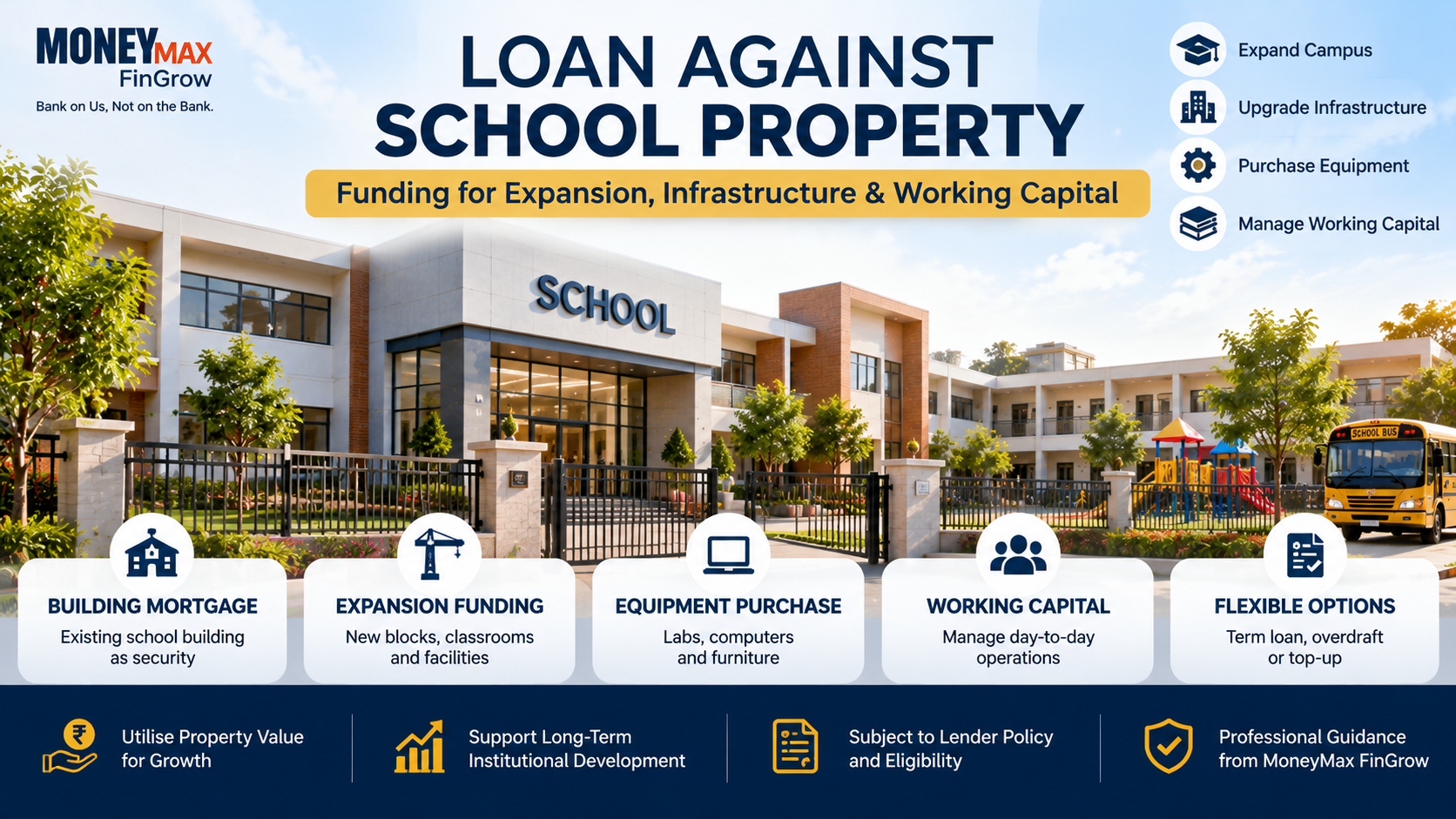
Can you get a loan against school property in India? Learn eligibility, trust-owned property rules, documents and funding options for school expansion.
Loan Against School Property in India: Eligibility, Documents & Funding Options
You Own a School Property. Can You Get a Loan Against It?
Let me ask you a simple question.
You are running a school.
Your school has been operating for 10 or 15 years.
You have hundreds of students.
You own land and a school building worth several crores.
Now you want to expand.
Maybe you want to construct another block.
Maybe you want to upgrade classrooms.
Maybe you want to build a laboratory, auditorium, or sports facility.
You approach a bank and say:
"I have a school property worth ₹10 crore. Can I get a ₹5 crore loan?"
The banker asks a very important question.
**"Who legally owns the school property?"**
You may say the property belongs to a trust.
Or a society.
Or a company.
Or an individual.
And this is where the entire funding process can change.
Because **getting a loan against a school property is not the same as getting a loan against a residential house or commercial shop.**
Let us understand how school property funding works in India.
1. Can You Get a Loan Against School Property in India?
Yes, financing against eligible school properties may be possible through certain banks and financial institutions.
However, not every lender accepts school buildings under its standard Loan Against Property (LAP) product.
Educational institutions are often treated as specialised borrowers or specialised-use properties.
A lender may assess:
- Legal ownership of the property.
- Whether the owner has the authority to mortgage it.
- Trust deed, society rules, or company documents.
- School recognition and applicable regulatory requirements.
- Approved construction and land use.
- Financial performance of the institution.
- Student-fee collections and other permitted income.
- Existing loans and repayment commitments.
- Whether the proposed loan purpose is permitted.
- Marketability and enforceability of the security.
**Important:** A valuable school building does not automatically qualify for a Loan Against Property.
2. Who Owns the School Property?
This is one of the first things to establish.
School properties may be owned by different types of entities.
A. Property Owned by an Individual
An individual may own the land and building and lease it to a school operator.
A lender may consider financing against the individual's eligible property, subject to title, land use, lease terms, legal permissions, income, and product policy.
The fact that a school operates in the building does not automatically make it acceptable under a standard LAP scheme.
B. Property Owned by a Private Limited Company
Some educational businesses or related infrastructure entities operate through companies.
Where legally permitted, a company-owned property may be considered for secured institutional finance.
The lender may require board approvals, constitutional documents, charge-related compliance, and other applicable authorisations.
C. Property Owned by a Trust
Many schools operate through public charitable trusts or other trusts.
This requires particular care.
The lender may need to examine:
- The trust deed.
- Trustees' authority to borrow.
- Trustees' authority to mortgage immovable property.
- Applicable state laws and permissions.
- Whether the proposed loan benefits the institution and is legally permitted.
- Restrictions attached to donated or endowed property.
**A trustee cannot automatically mortgage trust property merely because the trustee manages the school.**
Independent legal verification is essential.
D. Property Owned by a Registered Society
Schools may also operate through registered societies.
The society's governing documents, applicable laws, resolutions, and authority to borrow or create security must be examined.
Some properties may carry restrictions that make them unsuitable for mortgage financing.
3. Different Types of School Properties That May Be Considered
Depending on lender policy and legal eligibility, financing may be evaluated against:
- School land and completed buildings.
- Approved classroom blocks.
- Administrative buildings.
- Eligible institutional buildings.
- Additional land owned by the school or promoter.
- Separate commercial or residential properties owned by promoters.
Not all of these properties will qualify for the same loan product.
For example, a promoter's independently owned residential property may be evaluated differently from a school building owned by a charitable trust.
A school building may also have limited alternative commercial use, which can affect valuation and lender acceptance.
4. Why Banks Are Careful About School Properties
A residential house can often be sold to another residential buyer.
A commercial shop may be sold to another business owner.
But a school building is different.
It may have:
- Special land-use conditions.
- Institutional approvals.
- Restrictions on transfer.
- Trust or society ownership.
- Limited alternative uses.
- Ongoing educational operations.
- Regulatory requirements affecting enforcement.
Because of these factors, the lender may be cautious about accepting the property as security.
**The market value of the land and building is only one part of the assessment.**
5. Loan for School Expansion
Let us take an example.
A school has been operating for 12 years.
It has 1,200 students.
The management wants to construct another academic block and improve facilities.
The estimated project cost is ₹4 crore.
The school may explore a secured institutional term loan or project finance facility.
The lender will generally examine the project cost, management contribution, construction approvals, financial statements, fee collections, existing commitments, and projected repayment capacity.
Funds may be disbursed according to construction milestones or other approved conditions.
The bank may also require additional collateral or guarantees, depending on its policy.
**My suggestion:** Before approaching a bank, prepare a detailed project estimate and understand how the new investment will be repaid.
6. Loan for School Construction
Suppose you have purchased land and want to construct a new school building.
Can you obtain finance?
Potentially, yes, through an appropriate construction or institutional finance product.
But a school construction loan is not necessarily a standard LAP.
The lender may require:
- Clear land ownership.
- Permitted institutional land use.
- Approved building plans.
- Required permissions.
- Construction cost estimates.
- Promoter contribution.
- Financial projections.
- A credible repayment plan.
The lender may release funds in stages after verifying construction progress and fulfilment of conditions.
Do not assume that the entire sanctioned amount will be released on the first day.
7. Loan for School Renovation and Infrastructure
Educational institutions may require funds for:
- Classroom renovation.
- Science and computer laboratories.
- Furniture and equipment.
- Library development.
- Safety and accessibility improvements.
- Sports facilities.
- Technology upgrades.
- Other approved infrastructure requirements.
Depending on the nature of the expenditure, the school may evaluate an institutional term loan, equipment finance, or another appropriate funding facility.
Using an existing property as security may be possible where legally permitted and accepted by the lender.
8. Can a School Get a Working Capital Loan?
A school may experience timing differences between fee collections and operating expenses.
Salaries, maintenance, utilities, and other expenses may be payable before the next major fee collection period.
Some lenders may offer suitable working capital or institutional finance facilities to eligible educational entities.
However, loan availability and permitted use depend on the lender, the legal structure of the institution, and applicable regulations.
Before borrowing, the school should understand its cash flow.
A temporary cash flow gap is different from a long-term operating loss.
**Borrowing repeatedly to cover an ongoing deficit can create serious financial stress.**
9. How Much Loan Can You Get Against School Property?
This is one of the most common questions.
Suppose a school property has an estimated market value of ₹10 crore.
Can the school obtain ₹6 crore?
Not necessarily.
The lender may use its own valuation, apply a product-specific lending margin, or decline to accept the property entirely.
For illustration:
| Hypothetical accepted value | Illustrative LTV | Indicative funding | |---|---:|---:| | ₹5 crore | 40% | ₹2 crore | | ₹10 crore | 50% | ₹5 crore | | ₹15 crore | 40% | ₹6 crore |
These figures are purely mathematical examples, not standard school-property LTV ratios or indicative lender offers.
Actual eligibility depends on the property, institution, legal permissions, lender policy, and repayment capacity.
In some cases, an institutional loan may be assessed primarily on project viability and cash flow rather than a standard LAP percentage.
10. How Banks Evaluate a School's Repayment Capacity
This is where financial discipline becomes important.
Banks may examine:
**Student strength:** Current enrolment and historical trends.
**Fee income:** Actual collections, outstanding fees, and permitted fee structure.
**Operating expenses:** Teaching salaries, administration, maintenance, and other costs.
**Operating surplus:** Whether recurring income is sufficient to cover recurring expenses and debt obligations.
**Existing loans:** Current EMIs and other commitments.
**Cash flow:** Whether sufficient cash is available when repayments fall due.
**Future projections:** Whether the school can realistically support the proposed expansion.
For example, a school with valuable property but insufficient cash flow may not qualify for the requested loan amount.
**Property provides security. Cash flow provides repayment.**
11. Documents Required for a School Property Loan
The exact documents vary according to the ownership structure and lender.
School and Institution Documents
- Trust deed, society registration, or company incorporation documents, as applicable.
- Governing documents and authorised resolutions.
- School recognition and affiliation documents, where applicable.
- Applicable statutory permissions.
- Audited financial statements.
- Income tax returns and other applicable filings.
- Bank statements.
- Fee collection and student-enrolment information.
- Existing loan statements.
- Project report and estimates, if funds are for expansion.
Property Documents
- Sale deed and title chain.
- Encumbrance records.
- Land classification and revenue records.
- Approved building plans.
- Applicable completion or occupancy documents.
- Property tax receipts.
- Lease or allotment documents, if applicable.
- Permissions to mortgage where required.
Additional documents may be requested following legal and technical due diligence.
12. Can Trustees Mortgage School Property?
This question deserves special attention.
**Trust-owned school property cannot be assumed to be freely mortgageable.**
The answer depends on the type of trust, trust deed, applicable state legislation, property conditions, required approvals, and the purpose of borrowing.
A trustee resolution alone may not be sufficient.
For example, certain charitable or endowed properties may be subject to specific restrictions or approval requirements.
Before applying for funding, obtain a legal opinion from a qualified professional familiar with the relevant state's trust and property laws.
Never create a mortgage over school property without confirming the legal authority to do so.
13. What If the Bank Rejects the School Property?
A rejection does not always mean the school has no funding options.
It may mean:
- The lender does not accept educational properties.
- The institution's ownership structure is outside its policy.
- Mortgage permissions are incomplete.
- The property has approval or title issues.
- Repayment capacity is insufficient.
- The requested product does not suit the funding purpose.
Depending on eligibility, the institution or its promoters may explore other appropriate finance products or acceptable security.
However, a different lender cannot override legal restrictions on mortgaging property.
14. Five Mistakes School Owners Should Avoid
Mistake 1: Assuming Property Value Guarantees Funding
A ₹20 crore school property does not automatically qualify for a ₹10 crore loan.
Mistake 2: Ignoring Trust or Society Rules
Check whether
Comments
Be the first to comment on this article.