
Insights
Types of Loan Against Property (LAP) in India: Term Loan, Overdraft, Top-Up & Balance Transfer
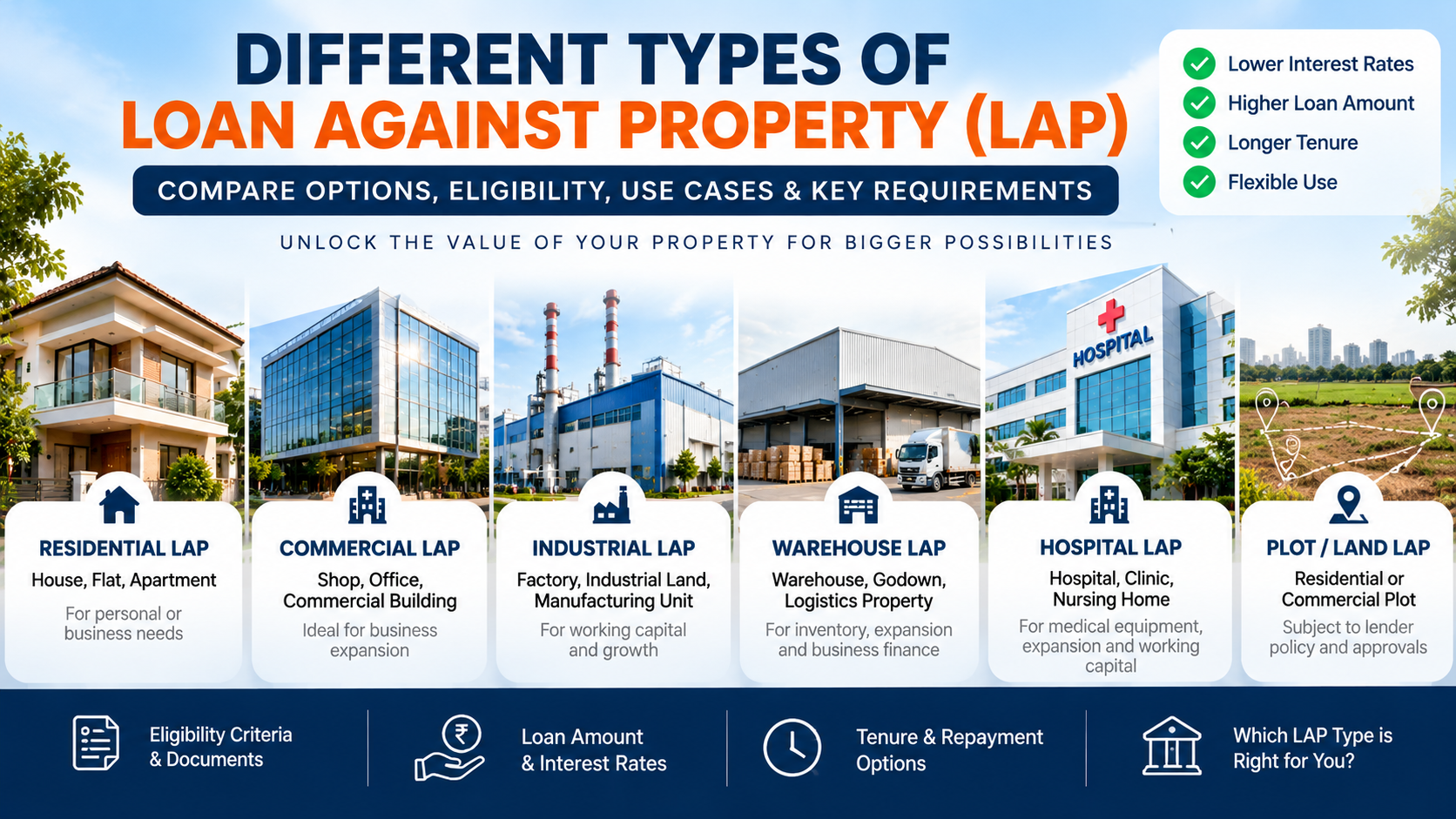
Explore types of Loan Against Property in India: term loan, overdraft, working capital, balance transfer, top-up and eligibility for business owners.
Types of Loan Against Property (LAP) in India: Term Loan, Overdraft, Top-Up & Balance Transfer
One Property. Different Funding Options. Which One Is Right for You?
Imagine you own a property worth ₹3 crore.
You want to expand your business.
You approach a bank and ask for a Loan Against Property.
The banker offers you a term loan.
But did you know that a term loan may not be the only option?
Depending on your property, income, business needs, and lender policy, you may also be eligible for an overdraft, working capital facility, balance transfer, or top-up loan.
Here is where many entrepreneurs make a mistake.
**They spend time comparing interest rates without first understanding which loan structure suits their requirement.**
Let us understand the different types of Loan Against Property in India, in simple language.
1. LAP Term Loan — For a Fixed Funding Requirement
A Loan Against Property term loan is one of the most common secured loan structures.
The bank sanctions an amount against an eligible property, subject to your financial and property eligibility.
The money is generally disbursed as a lump sum or according to the approved facility structure.
You repay it through scheduled EMIs over an agreed tenure.
Example
You need ₹75 lakh to purchase machinery.
You own an eligible residential or commercial property.
A bank sanctions a ₹75 lakh LAP term loan.
You use the money for the permitted purpose and repay the loan through monthly EMIs.
When is a LAP term loan suitable?
- Business expansion.
- Machinery purchase.
- Renovation.
- Eligible business investment.
- Other lender-permitted funding requirements.
**My suggestion:** A term loan is worth considering when you know exactly how much money you need and how the funds will be used.
2. LAP Overdraft — For Flexible Funding Requirements
An overdraft against property can be useful for businesses whose funding requirements change throughout the month.
Instead of receiving the entire loan amount as a conventional term loan, you may receive an approved overdraft limit.
You can withdraw funds up to the permitted limit and repay them according to the facility terms.
Interest is generally calculated on the amount utilised for the period of utilisation, subject to the lender's interest calculation method and applicable charges.
Example
Your business has an approved overdraft limit of ₹1 crore.
You currently need only ₹30 lakh.
You utilise ₹30 lakh.
When customers make payments, you deposit money back into the account.
Later, when you need funds again, you may draw from the available limit, subject to the account terms.
This can provide flexibility for working capital management.
When is a LAP overdraft suitable?
- Seasonal businesses.
- Traders and distributors.
- Businesses with fluctuating cash requirements.
- Short-term inventory purchases.
- Businesses with regular collections and payments.
**Important:** Overdraft facilities may involve renewal requirements, drawing conditions, charges, and periodic lender reviews.
An overdraft is not automatically cheaper than a term loan. Compare the full cost and repayment conditions.
3. Working Capital Loan Against Property
Many MSME owners struggle with one common problem.
Sales are growing.
Orders are increasing.
But money is stuck in stock and customer receivables.
They need working capital to run the business smoothly.
Eligible property may be offered as security for a working capital facility.
Depending on the lender, the product could be a cash credit facility, overdraft, or another secured business loan.
Example
A distributor has annual sales of ₹15 crore.
The business needs additional funds to maintain inventory and provide credit to customers.
The owner has an eligible commercial property.
The lender may evaluate a property-backed working capital facility based on business financials, operating cycle, collateral, and repayment capacity.
When is it suitable?
- Inventory purchases.
- Receivables funding.
- Supplier payments.
- Seasonal business requirements.
- Working capital gaps.
**Remember:** A property is security. It does not replace the need for a financially viable business.
4. LAP Balance Transfer — Move Your Existing Loan to Another Lender
Suppose you already have a Loan Against Property.
You have been paying your EMIs regularly.
But you feel the interest rate is high.
Or the repayment structure no longer suits your business.
You may consider transferring the outstanding loan to another lender.
This is called a Loan Against Property balance transfer.
Example
Your outstanding LAP is ₹1 crore.
Your current interest rate is 12% per annum.
Another lender offers an eligible balance transfer at 10.5% per annum.
The lower rate may reduce your interest cost.
But before transferring, compare processing fees, legal and valuation charges, applicable prepayment charges, remaining tenure, and the total cost of borrowing.
A lower interest rate does not always mean a better overall deal.
When is a balance transfer suitable?
- Existing LAP borrowers.
- Borrowers looking to reduce total borrowing cost.
- Borrowers seeking a more suitable repayment structure.
- Eligible borrowers who need a different lender relationship.
5. LAP Top-Up Loan — Additional Funding on an Existing Loan
What if you already have a Loan Against Property but need additional money?
You may not always need a completely new loan.
Some lenders offer a top-up facility to eligible existing borrowers.
The additional loan amount depends on factors such as current outstanding balance, updated property valuation, repayment history, income, and lender policy.
Example
You originally borrowed ₹1 crore.
After several years, the outstanding loan is ₹70 lakh.
Your property has an accepted valuation of ₹2.5 crore.
You need another ₹25 lakh for business expansion.
Your lender may consider a top-up, subject to its policy and your financial eligibility.
When is a LAP top-up suitable?
- Business expansion.
- Additional machinery.
- Eligible renovation expenses.
- Other permitted funding requirements.
**Important:** A top-up is not guaranteed merely because the property value has increased.
6. Loan Against Residential Property
Some lenders classify LAP products according to the type of property offered as security.
Residential LAP may be available against eligible independent houses, flats, or apartments.
The property can sometimes be self-occupied or rented.
Lenders evaluate the property's legal title, location, valuation, construction, approvals, and other requirements.
Residential property is often accepted under standard LAP schemes, but individual eligibility varies.
7. Loan Against Commercial Property
Do you own a shop, office, showroom, or commercial building?
Some banks and NBFCs accept eligible commercial property as collateral.
This can help business owners raise funds for approved purposes.
Commercial LAP eligibility depends on factors such as location, property use, title, approvals, marketability, and borrower income.
Different lenders may apply different lending margins.
8. Loan Against Industrial Property
Manufacturers may own factories, industrial buildings, or manufacturing sheds.
Some lenders provide secured funding against eligible industrial properties.
However, industrial LAP can require additional scrutiny.
The lender may examine land classification, statutory approvals, ownership rights, building plans, and resale potential.
A lender that accepts a residential house may not accept an industrial property under the same product.
9. Loan Against Warehouse or Godown
Warehouses are important assets for logistics operators, distributors, manufacturers, and investors.
Some lenders accept eligible warehouse and godown properties for secured funding.
The bank may evaluate the property's legal status, approved use, access, location, and marketability.
Where a warehouse generates rental income, other funding structures may also be worth evaluating.
10. Loan Against Hospital or Healthcare Property
Doctors and hospital owners may own hospital buildings, clinics, or nursing homes.
Certain lenders may consider these properties under specialised secured business finance products.
Because healthcare properties have specific uses and compliance requirements, acceptance is lender-dependent.
Hospital owners should compare LAP with healthcare project loans, equipment finance, and other suitable facilities.
11. Loan Against Plot or Vacant Land
Can you get a loan against an empty plot?
Some lenders accept approved vacant plots, while others do not offer standard LAP against open land.
Eligibility depends on land classification, approvals, location, title, and lender policy.
Agricultural land is generally excluded from many standard LAP schemes, although separate agriculture-related financing may be available to eligible borrowers.
12. Lease Rental Discounting — Funding Against Rental Income
Suppose you own a commercial building rented to a financially strong tenant.
You receive regular rental income.
You may be able to explore Lease Rental Discounting, commonly called LRD.
Under LRD, the lender assesses eligible future rental cash flows and the underlying security to determine the financing structure.
Example
You own a commercial building rented for ₹5 lakh per month.
You need funds for another investment.
A lender may assess the tenant, lease tenure, rental income, property, and other conditions before considering LRD.
**Important:** LRD is a separate secured lending structure. It should not be confused with a standard LAP term loan.
13. Which LAP Type Should You Choose?
| Your requirement | Facility worth evaluating | |---|---| | Fixed amount for business expansion | LAP term loan | | Fluctuating short-term fund requirement | LAP overdraft | | Inventory and receivables funding | Property-backed working capital | | Existing LAP at a higher borrowing cost | LAP balance transfer | | Additional funds on an existing LAP | LAP top-up | | Income-producing leased property | Lease Rental Discounting | | Funding against factory or warehouse | Specialised property-backed business loan |
These are starting points for comparison, not guaranteed product recommendations.
14. Loan Against Property Eligibility
Banks and NBFCs generally evaluate two important
Comments
Be the first to comment on this article.