
Insights
Which Properties Are Eligible for Loan Against Property (LAP) in India? Complete Guide
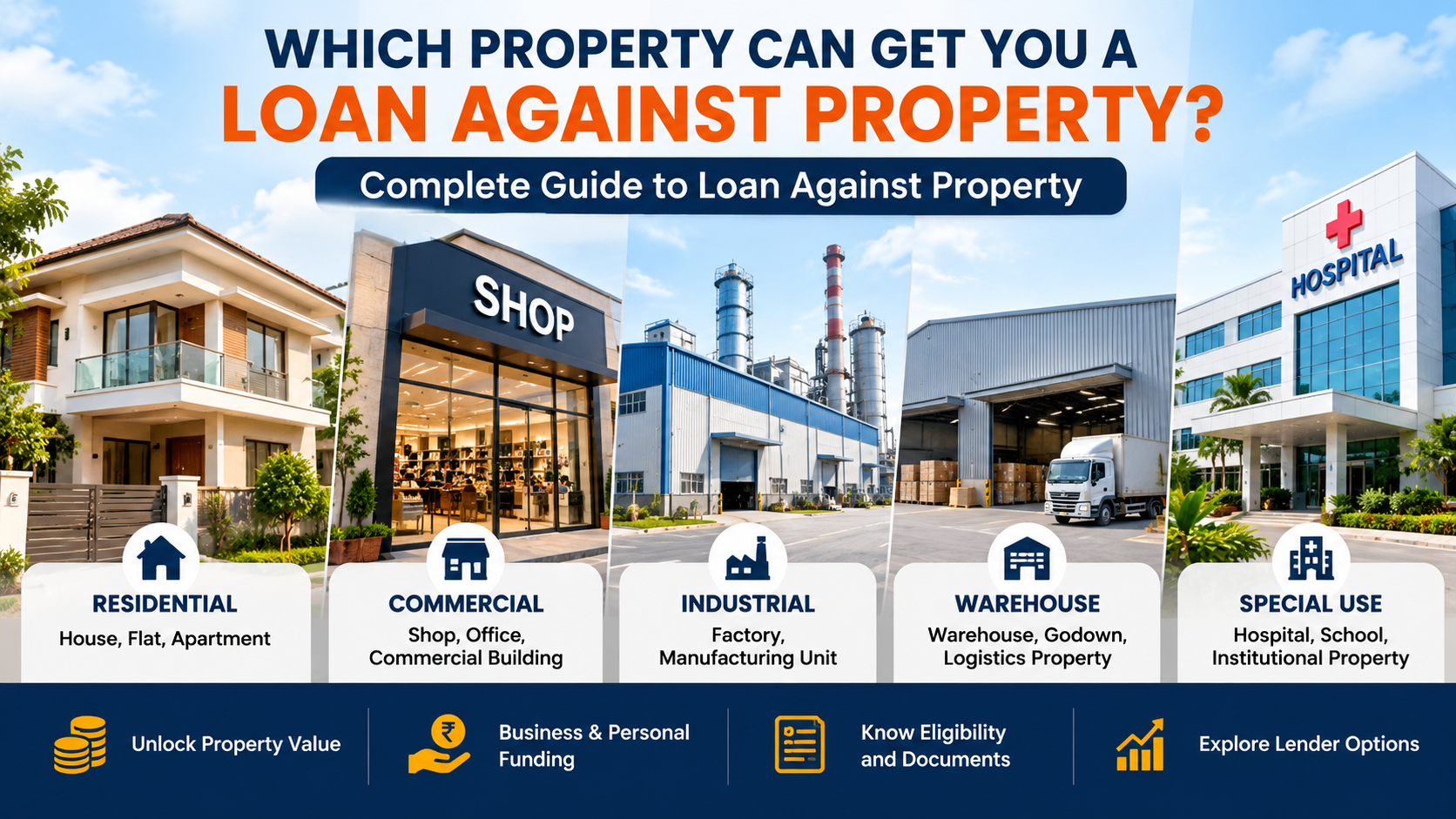
Can you get a loan against a house, flat, shop, warehouse, factory or land? Explore property types eligible for Loan Against Property in India.
Which Types of Properties Are Eligible for Loan Against Property (LAP) in India?
You Own a Property. But Can You Get a Loan Against It?
Let me ask you a simple question.
You own a property worth ₹2 crore.
You need ₹75 lakh to expand your business.
You approach a bank and say, "I have property. Can you give me a loan?"
The banker asks, "What type of property do you own?"
You say, "It's a factory."
Or maybe a warehouse.
Or a residential house.
Or a commercial shop.
Or even a vacant plot.
Now here is something every property owner should understand.
**Not every property is eligible for a Loan Against Property.**
And even when a property is eligible, every bank may not accept it.
Why?
Because banks look at more than the market value of your property.
They look at its location, legal status, approvals, ownership, construction, marketability, and your ability to repay.
Let's understand the different types of properties that may be accepted for a Loan Against Property (LAP) in India.
1. Residential House — Loan Against an Independent House
Do you own an independent house?
It could be your self-occupied house.
It could be a house given on rent.
Or it could be another residential property you own.
An eligible independent residential house can often be mortgaged to obtain a Loan Against Property.
**Example:**
Your house has an accepted bank valuation of ₹2 crore.
If the lender permits 60% Loan-to-Value (LTV), the indicative funding amount is ₹1.20 crore.
But this is only a property-value calculation.
Your income, existing EMIs, credit history, and repayment capacity determine whether you can actually qualify for that amount.
Before applying, check whether the building approvals, ownership documents, and property tax records are in order.
2. Residential Flat or Apartment — Can You Get LAP Against a Flat?
Yes, many lenders consider eligible residential flats and apartments.
This could include:
- Self-occupied flats.
- Rented apartments.
- Eligible investment properties.
- Apartments in approved residential projects.
Banks may check the age of the building, construction quality, location, approved plan, title documents, and remaining useful life.
For apartments, lenders may also review undivided share of land, completion or occupancy documentation where applicable, and other property records.
**Important:** A flat in a desirable location is not automatically eligible if its legal documents or approvals are defective.
3. Commercial Shops — Loan Against Shop Property
Are you a trader or retailer who owns a shop?
Your commercial shop may be eligible for property-backed funding.
For example, you may own:
- A textile showroom.
- A jewellery showroom.
- An electronics shop.
- A supermarket premises.
- A pharmacy premises.
- A commercial retail unit.
Suppose you own a commercial showroom worth ₹3 crore.
You need ₹1 crore for business expansion.
A lender that accepts commercial property may consider your application, subject to financial eligibility and legal and technical verification.
Commercial properties can have different valuation and lending margins compared with residential properties.
4. Commercial Office — Loan Against Office Property
Many business owners own their office premises.
It could be a small office in a commercial complex.
Or an entire office floor.
Or a standalone office building.
Eligible commercial offices may be accepted for LAP.
The lender may consider factors such as location, accessibility, building approvals, occupancy, rental arrangements, and resale potential.
If the office is leased to a tenant, the bank may also examine the lease agreement and other applicable conditions.
For income-generating commercial properties, a Lease Rental Discounting (LRD) facility may be another option worth evaluating.
5. Industrial Property — Loan Against Factory Building
This is especially important for MSME manufacturers.
You may own a factory in an industrial estate.
You may own industrial land with a constructed building.
You may have a manufacturing unit with a production shed.
Some banks and NBFCs accept eligible industrial properties as security.
However, industrial property lending can be more complicated than residential property lending.
Why?
Because lenders may examine:
- Industrial land classification.
- Ownership or leasehold rights.
- Approved building plans.
- Factory and statutory approvals, where applicable.
- Access roads and location.
- Marketability of the industrial property.
- Any restrictions on transfer or mortgage.
A factory worth ₹5 crore does not automatically qualify for a ₹3 crore loan.
Some lenders may apply a lower LTV to industrial property than to residential property.
**My suggestion:** Before applying, confirm whether the lender accepts your specific industrial property category.
6. Warehouse and Godown — Loan Against Warehouse Property
Do you own a warehouse?
Maybe you are into logistics.
Maybe you are a distributor.
Maybe you have constructed a godown and rented it to another business.
An eligible warehouse or godown may be considered as collateral by lenders that finance commercial or industrial properties.
Banks may examine:
- Land classification.
- Approved construction.
- Building use.
- Property ownership.
- Rental agreements, if applicable.
- Location and access.
- Valuation and marketability.
If the warehouse generates stable rental income, some borrowers may also explore rental-backed financing.
However, the funding structure depends on the lender and the property.
7. Hospital and Nursing Home Property
Doctors and hospital owners often ask:
"Can I mortgage my hospital building to raise funds for expansion?"
The answer is that some lenders may consider eligible healthcare properties, but acceptance is highly lender-specific.
A hospital is a specialised-use property.
The lender may review building approvals, ownership, legal compliance, property valuation, and its ability to enforce and realise the security.
A lender may accept the property under a specialised business funding product while another may decline it under a standard LAP scheme.
Hospital owners should compare LAP with hospital project loans, medical equipment finance, and other suitable healthcare funding facilities.
8. Educational Institution Property
What about a school building?
Or a college?
Or a training institution?
These properties need careful evaluation.
The property may belong to an individual, company, society, or trust.
Some lenders restrict properties owned by trusts or societies or properties used for particular social-sector activities.
Legal ownership, institutional regulations, mortgage permissions, and lender policy are especially important.
**Do not assume that a school or college building can be mortgaged just because it has a high market value.**
9. Vacant Residential Plot — Can You Get a Loan Against Land?
This is one of the most common questions.
"I have an approved vacant plot worth ₹1 crore. Can I get a loan against it?"
The answer is: **Possibly, but not with every lender.**
Some banks consider eligible vacant residential or commercial plots.
Others prefer completed buildings and do not accept open plots under their standard LAP products.
Banks may examine:
- Whether the plot is approved.
- Residential or commercial land classification.
- Ownership and title.
- Access to the property.
- Location and marketability.
- Restrictions on sale or mortgage.
The availability of a vacant plot loan depends heavily on the lender's policy.
10. Agricultural Land — Is It Eligible for Loan Against Property?
This is where many borrowers become confused.
Agricultural land is generally not accepted under standard retail LAP products offered by many banks.
However, this does not mean agricultural land can never support any type of borrowing.
Banks may offer separate agricultural mortgage or farm-related credit facilities to eligible borrowers for permitted agricultural purposes.
The applicable rules, borrower eligibility, land records, and permitted end use are different.
**Agricultural land loans and standard Loan Against Property products should not be treated as the same thing.**
11. Leasehold Property — Can It Be Mortgaged?
Suppose you operate a factory on industrial land allotted by a government development authority.
You may have a long-term lease rather than freehold ownership.
Can you obtain LAP?
Some lenders consider eligible leasehold properties.
But they may require:
- Sufficient remaining lease tenure.
- Mortgage rights under the lease.
- Permission or NOC from the lessor where applicable.
- Compliance with allotment conditions.
- Clear documentation.
A leasehold property is not automatically rejected, but the conditions are more specific.
12. Under-Construction Property
Can you mortgage a building that is still under construction?
This depends on the loan product.
Some standard LAP schemes exclude under-construction properties.
However, construction finance, project finance, or other secured lending products may be available for eligible projects.
The lender may assess construction progress, approvals, project cost, promoter contribution, and repayment capacity.
Do not confuse an under-construction property loan with a standard LAP against a completed property.
13. Which Properties Are Usually Difficult to Finance?
Let me explain something important.
A property may have a buyer in the market.
But a bank may still refuse to accept it as security.
Common reasons include:
**Disputed ownership:** Family disputes, pending litigation, or unclear title can create serious obstacles.
**Unapproved construction:** Significant deviations from approved building plans may affect eligibility.
**Agricultural classification:** Standard LAP schemes may exclude agricultural land.
**Restricted leasehold rights:** The lease may not permit mortgage without approval.
**Unclear access:** A property without legally established access can be difficult to finance.
**Existing mortgage:** A property already mortgaged may require a balance transfer, lender consent, or another permitted structure.
**Unmarketable location:** The lender may find the property difficult to sell if enforcement becomes necessary.
**Specialised property use:** Certain hospitals, schools, factories, and institutional buildings may be accepted only under specific policies.
The lesson is simple.
**Property value alone is not enough. Legal acceptability and repayment capacity matter equally.**
14. How Much Loan Can You Get Against Different Properties?
There is no universal Loan-to-Value percentage for every property.
Different lenders apply different margins.
For illustration, consider the following calculations:
| Accepted property value | Illustrative LTV | Indicative loan | |---|---:|---:| | ₹1 crore | 50% | ₹50 lakh | | ₹2 crore | 60% | ₹1.20 crore | | ₹3 crore | 65% | ₹1.95 crore | | ₹5 crore | 50% | ₹2.50 crore |
These percentages are examples for understanding the calculation, not promises or standard rates for particular property categories.
Actual loan eligibility can be lower because of income, existing liabilities, credit assessment, property valuation, or lender policy.
15. Documents Required for Loan Against Property
Before approaching a lender, prepare your documents.
Property Documents
Depending on the property and state, the lender may ask for:
- Sale deed or other title deeds.
- Parent or chain documents.
- Encumbrance certificate or equivalent records.
- Patta, mutation, or revenue records where applicable.
- Approved building plan.
- Completion or occupancy documentation where applicable.
- Property tax receipts.
- Lease or allotment documents where relevant.
- Other legal and technical documents.
Borrower Documents
The lender may also require identity and address proof, income tax returns, financial statements, bank statements, existing loan details, and business registration records.
The exact checklist depends on the lender and applicant.
16. Five Questions to Ask Before Applying for LAP
Before applying for a Loan Against Property, ask yourself:
**1. Is my property legally clear?**
Are the ownership and approval documents complete?
**2. Does the bank accept this property type?**
A lender accepting residential property may not accept a factory or vacant plot.
**3. How much loan do I actually need?**
Do not borrow the maximum merely because the bank offers it.
**4. Can I repay the EMI comfortably?**
Consider existing loans, business cash flow, and future financial commitments.
**5. Will the loan help me create more value?**
If you are borrowing for business, understand how the funds will improve revenue, profitability, efficiency, or financial stability.
17. Why Choosing the Right Lender Matters
Imagine you own a warehouse worth ₹6 crore.
You approach one bank.
The bank says, "We do not accept this property category under our LAP scheme."
You assume you cannot get funding.
But the actual problem may be that you approached a lender whose product does not suit your property.
Another lender may have a policy for eligible warehouse or industrial properties.
This is why understanding lender policies matters.
At MoneyMax FinGrow Private Limited, our focus is to help entrepreneurs evaluate their funding requirements, financial eligibility, and suitable lender options.
The objective is not simply to obtain a loan.
**The objective is to obtain the right loan, against the right property, with a repayment structure that supports your financial future.**
Frequently Asked Questions
Can I get Loan Against Property on an independent house?
Yes, eligible independent residential houses are commonly considered by LAP lenders, subject to legal, technical, and borrower eligibility.
Can I get LAP against a commercial shop?
Yes, some banks and NBFCs accept eligible commercial shops as collateral.
Can I mortgage my factory for a business loan?
Some lenders accept industrial land and buildings, subject to their lending policies and property documentation.
Can I get a loan against a warehouse?
Eligible warehouses and godowns may be considered by lenders that accept commercial or industrial properties.
Can I get a loan against a vacant plot?
Some lenders accept eligible vacant plots, while others exclude them under standard LAP schemes.
Can I get LAP against agricultural land?
Agricultural land is generally excluded from many standard LAP schemes. Separate agriculture-related financing may be available to eligible borrowers.
Can I get a loan against property without income proof?
Lenders generally require a verifiable source of repayment. Some may accept alternative forms of income assessment, but owning property alone does not guarantee loan eligibility.
Can I get a loan against a property that is already mortgaged?
Depending on the lender and existing loan terms, balance transfer, top-up, or other approved financing structures may be possible.
Which property is best for Loan Against Property?
There is no single best property type. Eligibility depends on title, location, approvals, valuation, marketability, borrower finances, and lender policy.
Final Thoughts
Your property may be one of your biggest financial assets.
It may be a house.
A flat.
A shop.
An office.
A factory.
A warehouse.
Or a commercial building.
But remember this.
**Owning a valuable property does not automatically make you eligible for a valuable loan.**
Before applying, understand the property's eligibility, your financial position, and the purpose of borrowing.
Because taking a loan is easy to discuss.
Repaying it is a long-term responsibility.
At MoneyMax FinGrow, we believe that the right financial decision begins with clarity.
Need a Loan Against Your Property?
Are you a business owner looking for funding against your house, commercial building, factory, warehouse, or another eligible property?
MoneyMax FinGrow Private Limited can help you evaluate suitable funding options.
Visit: https://moneymaxfingrow.com
**MoneyMax FinGrow Private Limited**
**Bank on Us, Not on the Bank.**
*Disclaimer: Property acceptance, loan amount, interest rate, tenure, and eligibility vary by lender, product, legal and technical assessment, and repayment capacity. This article is educational and does not guarantee loan approval.*
Comments
Be the first to comment on this article.