
Business Loans
How to Get a Business Loan in India: 5 Hacks Before You Apply (2026)
Sep 17, 2026
Most business owners in India don't lose money on the loan they were refused — they lose it on the loan they took badly. Wrong lender, wrong structure, wrong tenure, too many applications. These five hacks are the ones our advisors repeat in almost every sanction conversation, and they decide whether a loan supports growth or chokes cash flow.

Note: rates, fees and lender policies mentioned below are indicative market ranges and vary by lender, profile and security. Always confirm the exact terms in your sanction letter before signing.
Hack 01: Don't apply everywhere at once
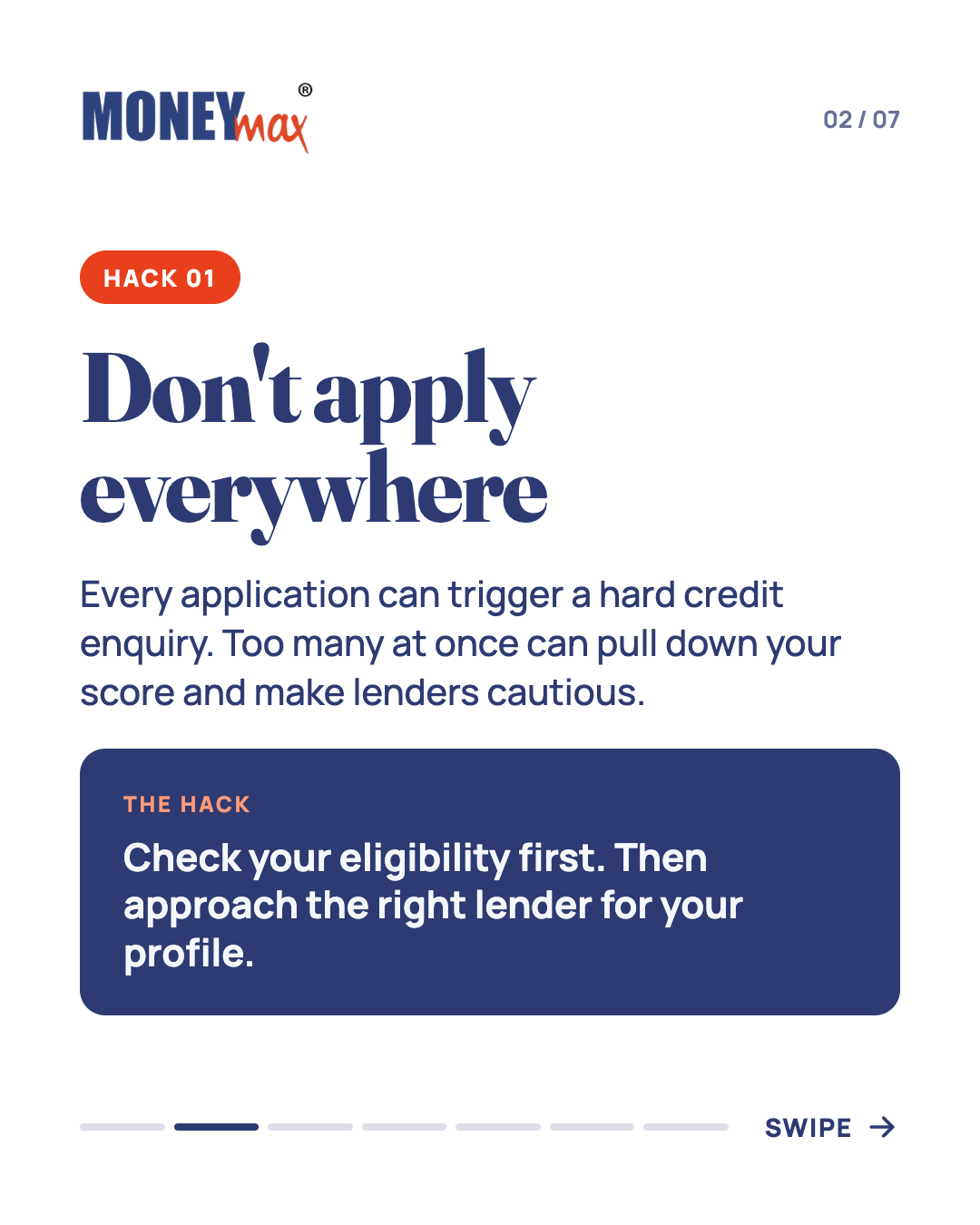
Every formal application can trigger a hard credit enquiry on your CIBIL report. Four or five enquiries within a few weeks pull the score down and, worse, tell the next underwriter that others may already have declined you. We routinely see files that would have sanctioned at 9% get priced higher — or rejected outright — purely because of enquiry pile-up.
The fix is sequence. Establish your profile first: turnover, vintage, banking conduct, existing obligations and whether you can offer security. Then approach the one or two lenders whose policy actually matches that profile. Start with our business loan eligibility calculator and the 2026 eligibility checklist before a single application form is filled.
Hack 02: Don't look only at the interest rate
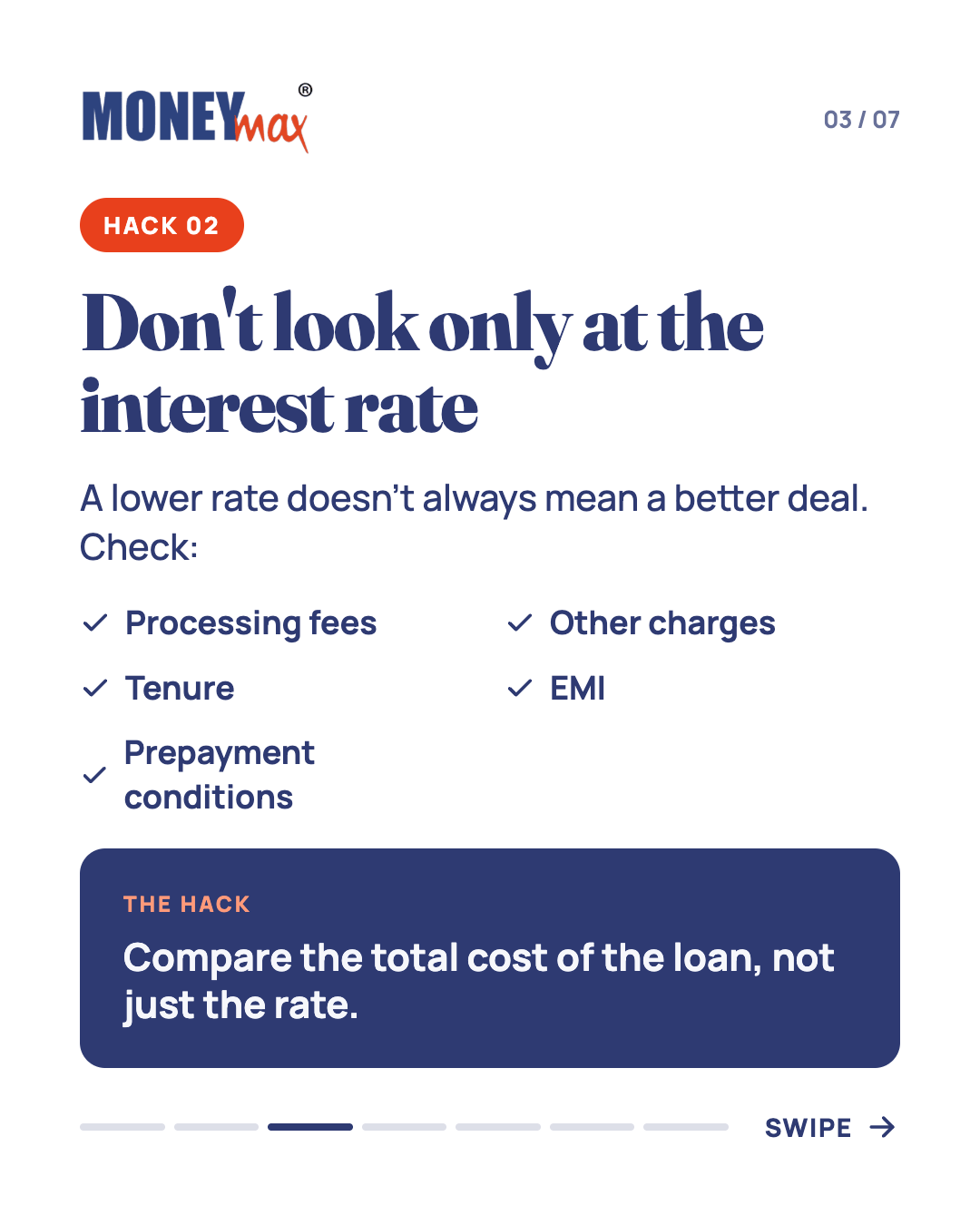
A lower headline rate does not mean a cheaper loan. Check all six:
- Processing fee — typically 0.25%–2% of the sanction, often negotiable.
- Other charges — legal, valuation, documentation, stamping, insurance loading.
- Tenure — a longer tenure lowers EMI but raises total interest paid.
- EMI — what your cash flow actually has to absorb every month.
- Prepayment conditions — lock-in periods and foreclosure charges.
- Rate type — fixed or floating, and what benchmark it is linked to.
A worked example on a ₹50 lakh facility: 10.5% with a 2% fee and a 12-month lock-in can end up costlier than 11% with a 0.5% fee and nil foreclosure after six months — especially if you plan to prepay from seasonal collections. Run both through the EMI calculator before you decide, and read our 10 checks before signing a sanction letter.
Hack 03: Multiple loans? Review them
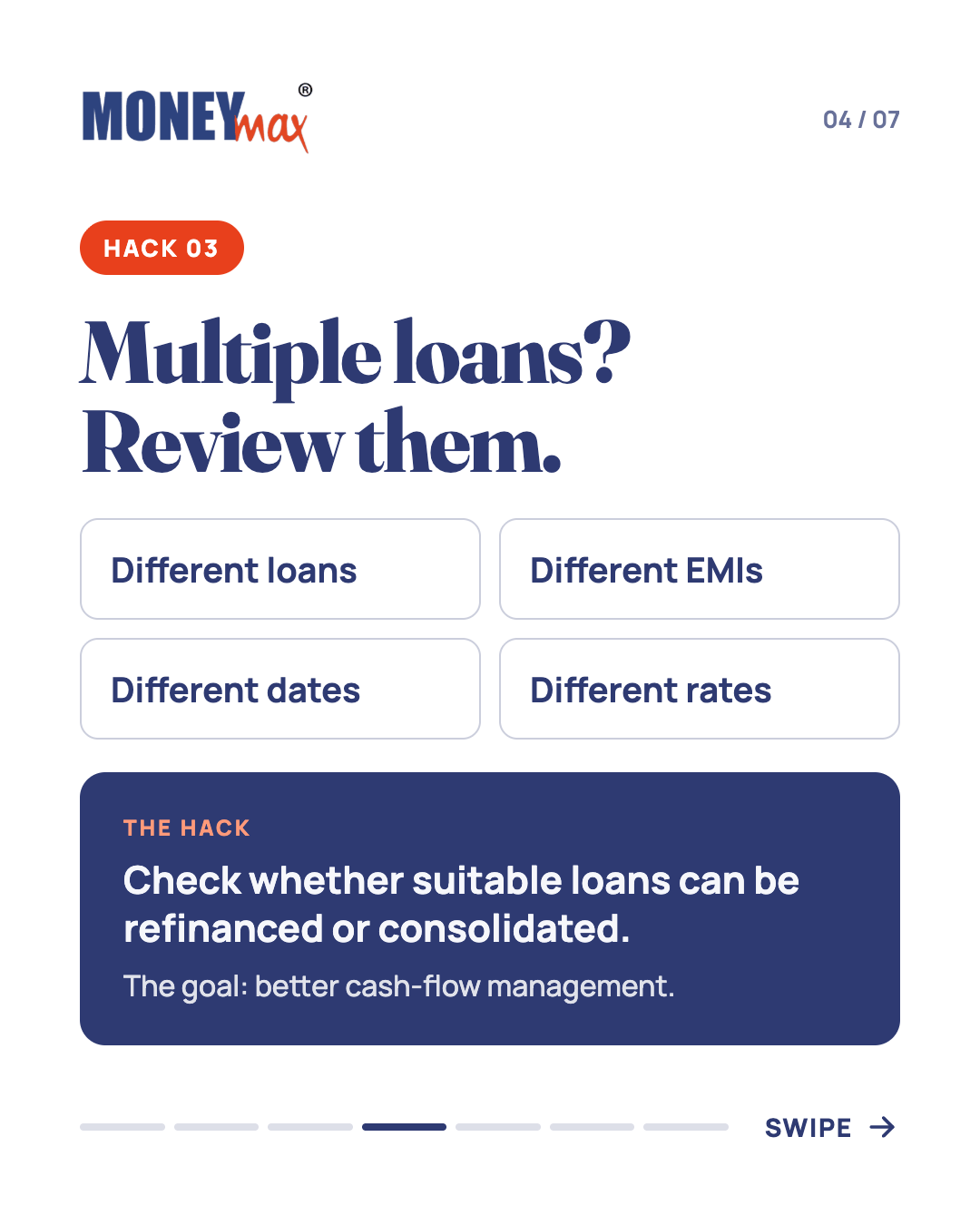
Different loans, different EMIs, different dates, different rates. Most MSME owners carrying three to five facilities have never added up the blended cost — and that is where the money leaks. An unsecured business loan at 18%–22% sitting alongside property you already own is the clearest case for restructuring.
Check whether the suitable ones can be refinanced or consolidated into a single secured facility. A LAP-based consolidation at around 9%–11% replacing high-cost unsecured EMIs commonly cuts monthly outgo by 30%–50%, with one date and one lender to manage. The goal is cash-flow control, not just a lower rate. See debt consolidation, the savings calculator and our guide to reducing your existing EMI.
Hack 04: Match the tenure to the purpose
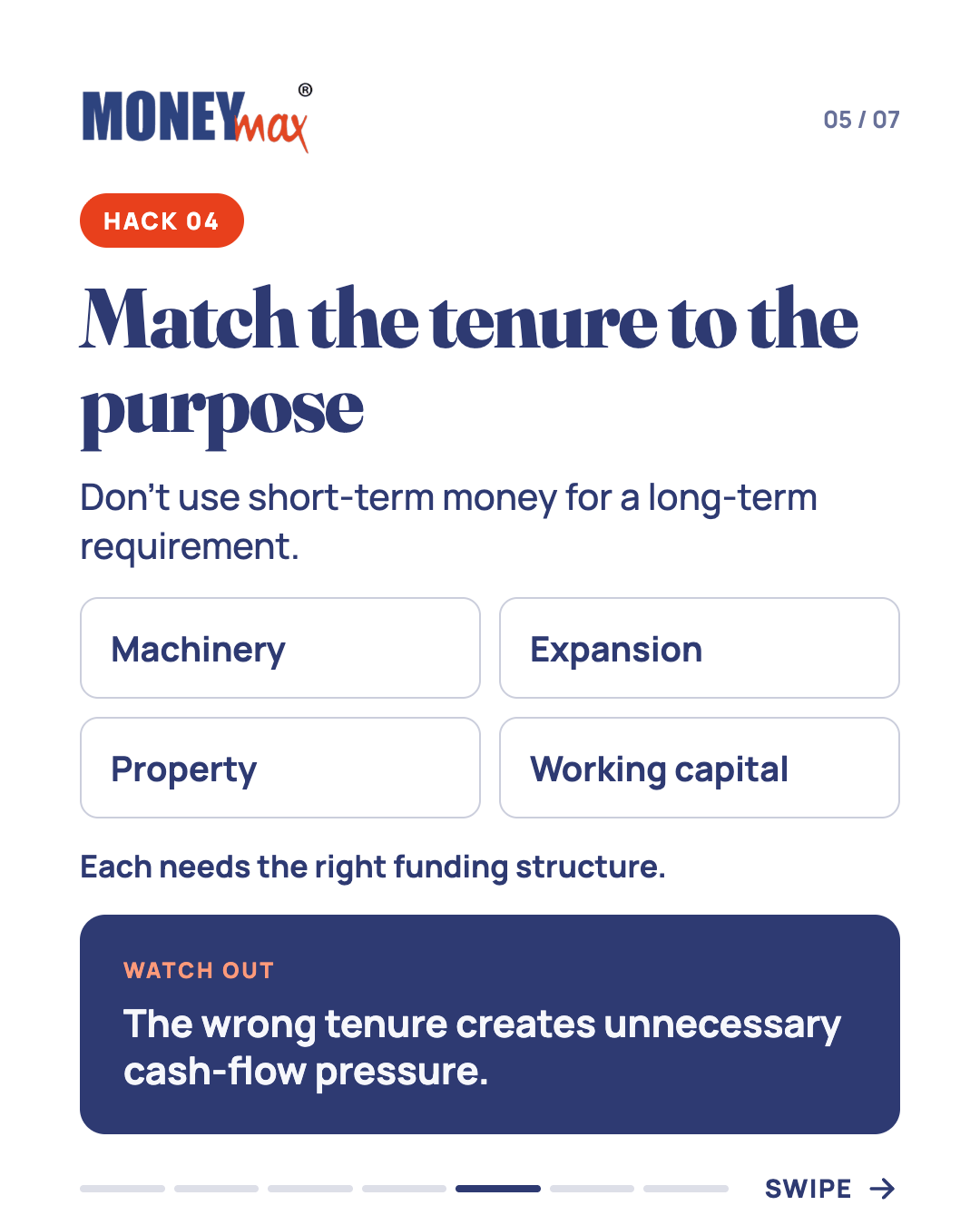
Don't use short-term money for a long-term requirement. Each need has a structure that fits it:
| Requirement | Right structure | Why |
|---|---|---|
| Working capital / receivable gap | Overdraft or cash credit | Revolves with the cycle; interest only on utilisation |
| Machinery / equipment | Term loan | Tenure aligned to the asset's useful life |
| Expansion / new unit | Term loan or LAP | Longer repayment matches a slower payback |
| Property purchase / large consolidation | Loan against property | Lowest cost, 10–15 year tenure, large ticket |
The wrong tenure creates unnecessary cash-flow pressure: a 3-year term loan funding a machine that pays back over 7 years will starve the business in years one and two, even though the project is sound. Read more on matching loan purpose to product.
Hack 05: Don't borrow just because you can
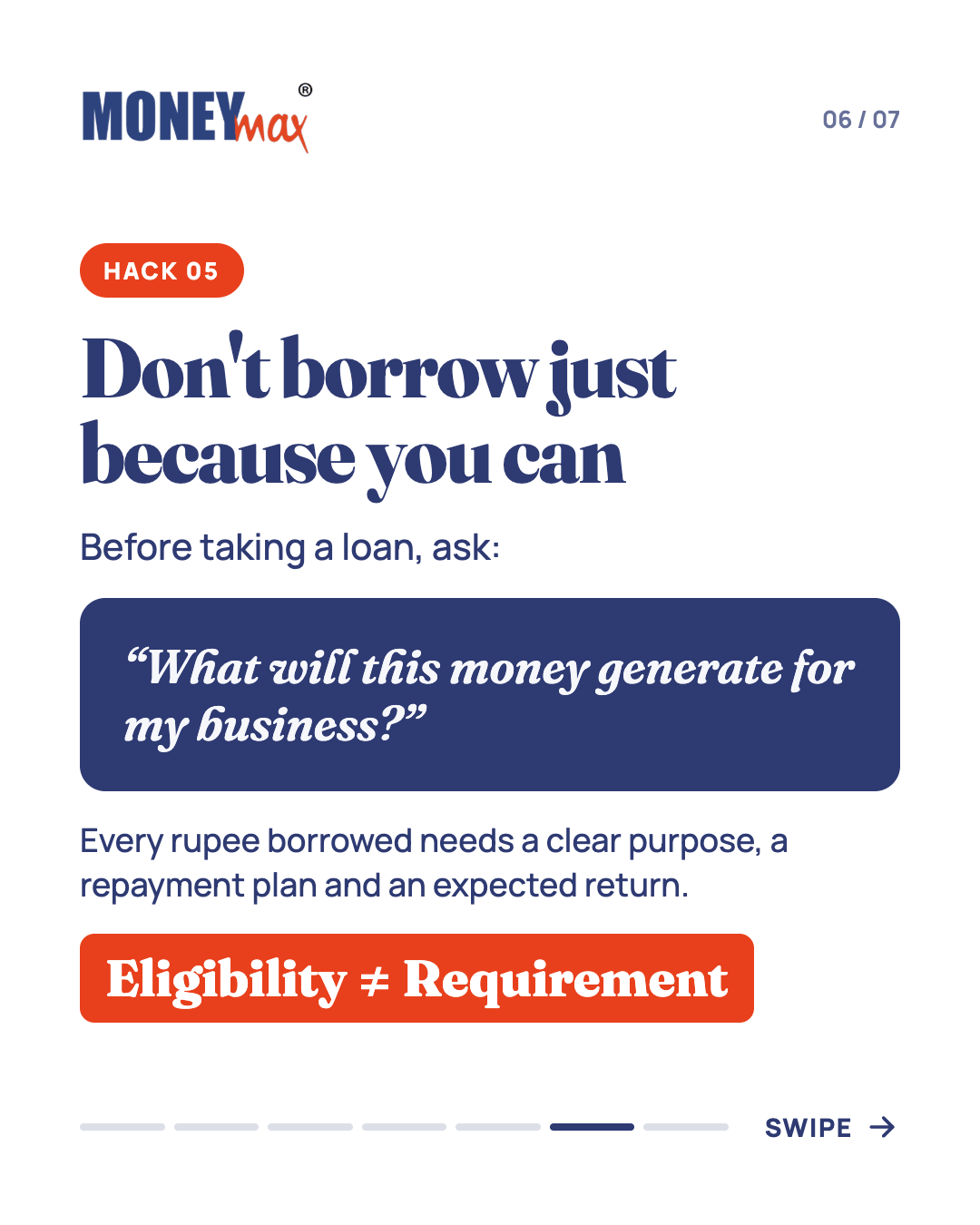
Before taking a loan, ask one question: "What will this money generate for my business?" Every rupee borrowed needs a clear purpose, a repayment plan and an expected return above the cost of funds. A ₹1 crore sanction that sits idle in the current account still costs roughly ₹9–11 lakh a year.
Eligibility ≠ requirement. Banks quote what they are willing to lend; you decide what the business can deploy productively. Use the loan requirement calculator to size the ask before you hear a number from a lender.
Get these six right before borrowing

A good loan should support growth, not choke cash flow. Six things decide that: the right amount, right product, right lender, right rate, right tenure and right EMI. Get five right and the sixth will still hurt you — the tenure or the foreclosure clause is usually the one that gets missed.
Run a free 30-second loan health score to see where your current borrowing stands, or check your eligibility without a hard credit enquiry.
Frequently asked questions
Does applying to many banks at once reduce my chances?
Yes — each application usually triggers a hard enquiry. Several in a short window pull the score down and signal credit hunger. Check eligibility first, then approach the right lender.
Is the lowest interest rate always the cheapest loan?
No. Fees, tenure, insurance loading and foreclosure terms can make a lower-rate loan more expensive over its life. Compare total cost.
Can I combine multiple business EMIs into one?
Often yes, through refinancing, balance transfer or a LAP-based consolidation — typically cutting monthly outgo by 30%–50% where property security is available.
How much should I actually borrow?
The amount with a defined purpose, a repayment plan from business cash flows, and an expected return higher than the cost of the loan.
Comments
Be the first to comment on this article.